
First, I apologize for my extended absence from blogging. A number of things blew up both at work and home. That said, let’s continue our multiple-part census discussion with the 1920 census and beyond!
In the last post, I found evidence of my great grandfather’s home, siblings, work, and general life. This is an excellent starting point, and now it is time to continue working backwards. I have his name, John Siems, birth date of about 1896, and will assume his location is still Bridgeport, Michigan. Plugging in just this information into the search engine gave a great result – he was the first entry!
This time, he was living with his parents John and Margarete as well as his siblings who were listed in 1930. If I had not already known his parents’ names, this would be great additional information! I also know now that the elder John’s parents were both born in Germany, as well as his wife Margarete (as recorded in 1930). This also gives me a timeline – it is very likely both John and Margarete died in the 1920s, as the family was together in 1930 but without their parents.
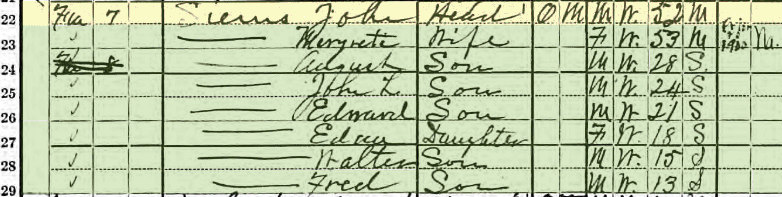
Another interesting bit of information is that Margarete immigrated prior to 1900 and was a naturalized citizen in 1920.
Naturally, the next step is the 1910 census. And I find something fantastic here. Can you spot it in the image below?
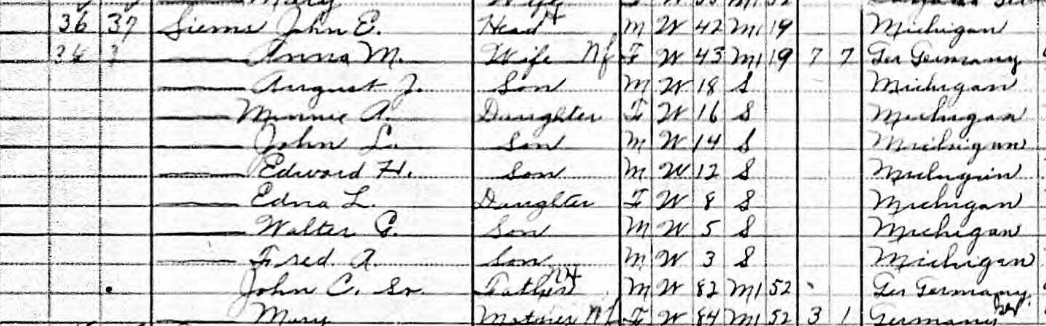
The first couple lines are interesting themselves…a year of marriage for John E. Siems and Anna M. (Anna Margarete) of around 1891, along with the fact that 7 children were born to them and all 7 were still living. Counting, we see all 7 are in the household at the time of the census as well. But after the head of household, wife, and sons and daughters, look who we find! The parents of John E. Siems – John C. and Mary. I have found the original German settlers of my Siems line here in the 1910 census.
It does not always happen, but many times we can find the parents, in-laws, siblings, or cousins of our ancestors living with them or next door.
Just from the 1910 – 1930 census records, I have gone back three generations from my grandfather to our first German ancestors in the USA.
These examples are best case scenarios. They were easy to search out, I had a good starting point from oral family history, and everyone was living together and in the same place. However, things are about to get a bit more difficult tracking down the older generations. In my last post of this first census series, I will discuss how I broke through the very first brick wall of my family tree to track the Siems family all the way back to 1860 in Saginaw.
Are you having difficulty in your own census search, need help interpreting what you found, or are ready to move beyond the census? Contact us for a free research proposal, we’d love to help!
 Weaving the Tapestry
One thought on “Journeying Through Time with the Census”