
Tracing the Beginning with the Census

In this final beginning census tips post, we will cover what can be done to get around what appears to be missing ancestors.

From the previous post, I know that my first Siems ancestors in the USA, John C., was born in about 1828. I also know that, because his son John E. was born about 1868 in Michigan, they were likely living in the state since at least that time.

The 1900 census does not give me much more than I already knew, so it is time to skip back to 1880. Why not 1890? Unfortunately, all but a few fragments of the 1890 US Federal Census have been destroyed by a fire. While there are some sources that can be used in place of this census, it really is frustrating and unfortunate. But, on to 1880 it is.

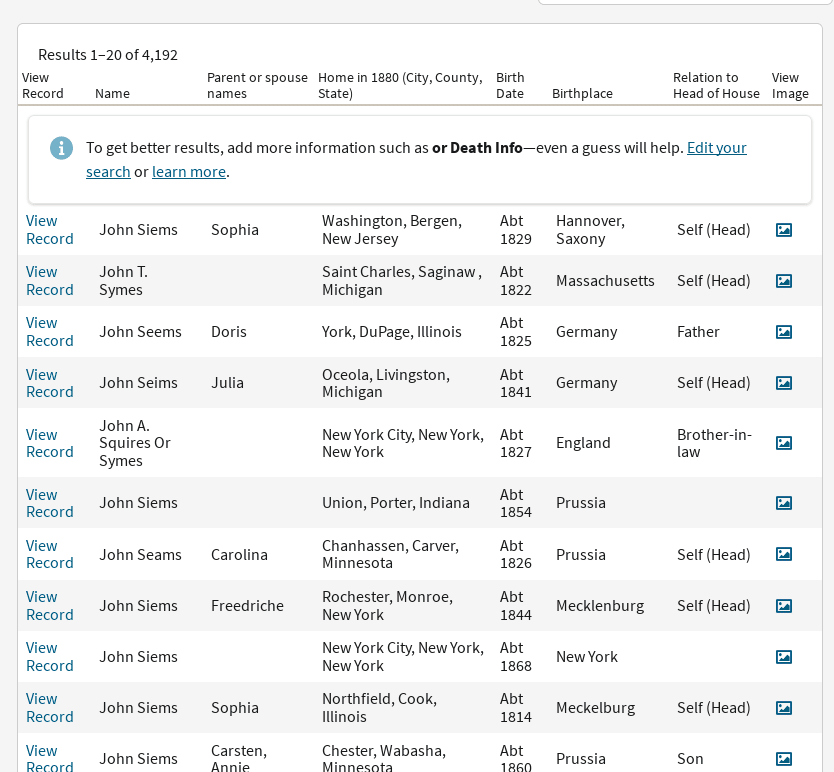
As before, I enter in John C. Siems’ name, approximate birth year, birth place of Michigan, and residence in Bridgeport, Michigan. This was the result.
Screenshot from 2020-02-16 11-13-45

Uh oh. Only two of these results is for a Michigan resident, and they certainly are not my John C. What now?

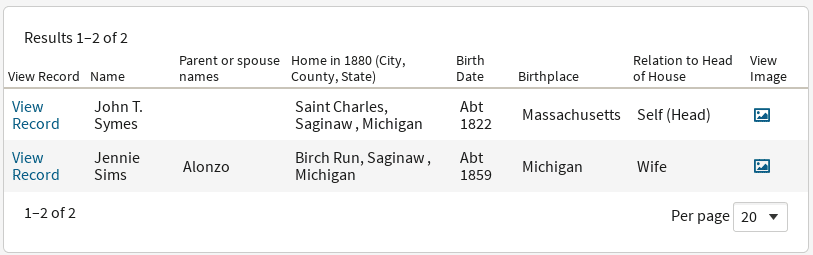
Narrowing results only to Saginaw County was no help. They didn’t live near their neighbors from 1900 either.
Screenshot from 2020-02-16 11-16-29

Was I assuming incorrectly that they were still settled in Saginaw County? Instead of expanding out, I took the assumption their name was spelled incorrectly and searched for John born in 1828 in Germany in Saginaw County, entering no last name. Look who came up on the first line.

Screenshot from 2020-02-16 11-25-29

If you are running into issues with searching through indexes like this, the “drop a hard to spell name” method has helped me numerous times, and not just for the census. Not only was their name spelled Seams rather than Siems by the census taker, it was transcribed incorrectly to Seann, which meant the search engine was not able to make a connection between my search the way it may have been able to with Seams using the soundex.

Knowing the Seams spelling got me back to 1870 with ease (where, though I didn’t realize it at the time due to issues with numbering households on the original document, Mary’s father was living with the family). However, nothing was easy about tracking them in 1860. I originally did this work over 10 years ago, and in my early researcher naiveté, I went through the entire county of Saginaw line by line until I found them. But I simply could have done the “drop the last name” method, right?

Um…no. It’s not working. Not with Mary, either.

What I ended up doing was casting a wide net by searching for John, born in 1828 +/- 5 years, and limited results to Saginaw County, Michigan. Then, I browsed through the many, many search results for someone whose last name remotely looked like Seams, born somewhere that remotely looked like Mecklenburg.

I clicked on a number of possibilities before finding him on page 7 of my results. Enter John Swins, born about 1831 in Mecklenburg, living in the city of Saginaw with his wife Mary and an older gentleman named John Azet (who I found years later to be Mary’s father, John Christian Eggert).

I can’t blame all this on the transcriber, though.

Screenshot from 2020-02-16 11-52-18

With nothing to be found in 1850, here my census journey ended. I now had a lot of information to go on, including but not limited to:

  • John C. Siems and his wife Mary immigrated to Saginaw from Mecklenburg and settled in nearby Bridgeport. John C. and Mary were married about 1858, probably either in Mecklenburg or Saginaw.
  • Their child John E. Siems married a Margarete around 1891 and raised his family of 7 children in Bridgeport.
  • John C. and Mary both likely died in Bridgeport in the 1910s.
  • John E. and Margarete both likely died in Bridgeport in the 1920s.

From here, I can search out birth records of the children, marriage and death records of the parents, and evidence of the ocean passage of John C. and Mary. Over the years, I was able to track down both John C. and Mary’s hometown in Mecklenburg and start tracing their ancestry through the German church records. I am back to Johann Friederich Ziems, born about 1740, my 6th great grandfather. It all started from this census search.

If you’re just beginning to research your family tree in the United States, collect the information you have and start with a census search in 1940. Go back each year until you just can’t find them anymore, then compile all the information you found in those census documents. It is a great springboard for investigating further.
Journeying Through Time with the Census

First, I apologize for my extended absence from blogging. A number of things blew up both at work and home. That said, let’s continue our multiple-part census discussion with the 1920 census and beyond!

In the last post, I found evidence of my great grandfather’s home, siblings, work, and general life. This is an excellent starting point, and now it is time to continue working backwards. I have his name, John Siems, birth date of about 1896, and will assume his location is still Bridgeport, Michigan. Plugging in just this information into the search engine gave a great result – he was the first entry!

This time, he was living with his parents John and Margarete as well as his siblings who were listed in 1930. If I had not already known his parents’ names, this would be great additional information! I also know now that the elder John’s parents were both born in Germany, as well as his wife Margarete (as recorded in 1930). This also gives me a timeline – it is very likely both John and Margarete died in the 1920s, as the family was together in 1930 but without their parents.

Screenshot from 2020-02-16 10-41-52

Another interesting bit of information is that Margarete immigrated prior to 1900 and was a naturalized citizen in 1920.

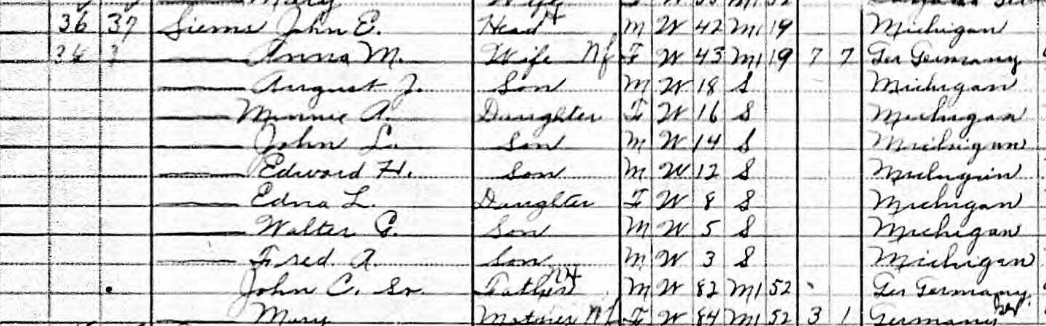
Naturally, the next step is the 1910 census. And I find something fantastic here. Can you spot it in the image below?

Screenshot from 2020-02-16 10-47-56

The first couple lines are interesting themselves…a year of marriage for John E. Siems and Anna M. (Anna Margarete) of around 1891, along with the fact that 7 children were born to them and all 7 were still living.  Counting, we see all 7 are in the household at the time of the census as well. But after the head of household, wife, and sons and daughters, look who we find! The parents of John E. Siems – John C. and Mary. I have found the original German settlers of my Siems line here in the 1910 census.

It does not always happen, but many times we can find the parents, in-laws, siblings, or cousins of our ancestors living with them or next door.

Just from the 1910 – 1930 census records, I have gone back three generations from my grandfather to our first German ancestors in the USA.

These examples are best case scenarios. They were easy to search out, I had a good starting point from oral family history, and everyone was living together and in the same place. However, things are about to get a bit more difficult tracking down the older generations. In my last post of this first census series, I will discuss how I broke through the very first brick wall of my family tree to track the Siems family all the way back to 1860 in Saginaw.

Are you having difficulty in your own census search, need help interpreting what you found, or are ready to move beyond the census? Contact us for a free research proposal, we’d love to help!

The Census – More Than Just a Name

Today is the first of a multi-part post in which I wanted to share some useful tips for using census records. My examples are from the U.S. Federal Census, but can also apply to state census records and census records in the British Isles, or perhaps even beyond.

The U.S. Census remains confidential for 72 years, after which it is released to the public. Census records start in 1790, the first decade of our country’s independence, and are available through 1940. Some county and state level records losses have happened, and of course the tragic loss of the 1890 census for almost the entire country. There are also ethnic variations that may limit the usefulness of these records: American Indians may not find ancestors until more recent records, or in special Indian census records, and African American ancestors who were enslaved will not appear until the first post-Civil War census of 1870.

But let’s say you’ve found your ancestor in a census record. What more does this give you than a name? Loads, as it turns out! I’ll start with a 1930 census example from my own tree.

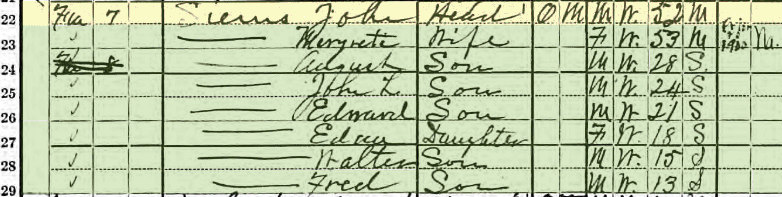
My grandfather was not living with his father in 1930. I knew that already – my grandfather’s mother had died when he was only about 18 months old and he lived with her sister while his father returned to his home, as back then it was very difficult to successfully live as a single father. Although I already knew a lot about my great grandfather, including his siblings’ and parents’ names, from my grandfather, I still looked him up in 1930.

Screenshot from 2019-12-15 16-46-47

I saw him living with his brother August at their parents’ farm on King Road. Also living with them were his brother Walter and Walter’s new wife Lillian, who was born in Germany, and their youngest brother Frederick. Their two sisters and other brother appeared to be out of the household as well as the parents (presumably deceased). August was not married and was working the farm, but his brothers were out working elsewhere. The census shows my great grandfather was an automobile salesman, something I had never heard. And while the family’s mother was born in Germany as expected, I was surprised to discover their father was born in Michigan.

To summarize, this document gave me the following information:

  • Town and road on which my great grandfather lived
  • Several of his siblings’ names
  • The names of his neighbors
  • His oldest brother owned the farm and worked it
  • They owned a radio
  • He was male, white, 34 years old, widowed, and first married at age 26
  • He did not attend school that year, but could read and write
  • He was born in Michigan, his father was born in Michigan, and his mother was born in Germany
  • He was able to speak English
  • He worked as an automobile salesman for a wage
  • He was not a verteran

While some information is just of general interest, like the fact that they owned a radio or his job, much will help me track him the next census back in 1920. I’ll be able to narrow in on the King Road address and should find him living with a father from Michigan and mother from Germany, along with siblings named August, Walter, and Frederick. He would also be about age 24. It also gives me an approximate year of 1922 for his marriage. And, if I have trouble finding his family (Siems often is written or transcribed incorrectly), I can search for the names of his neighbors to get in the ballpark area where he may be enumerated.

Next post we will visit the 1920 census to see what more we learn of my great grandfather and helpful information available from that year.
