BMD Step 2 – Marriage Records

I know from oral family history that John L. Siems married twice, with his first wife being my ancestor. He later married a woman with three children and had his second child, my grandfather’s younger sister.

As with death records, if you don’t know where to start you may want to begin with a search such as “marriage records <city, state, or country>”. Different regions will have different availability of records.

Luckily for me, marriage record entries (if not certificates) are available for Michigan for the dates I need. From a search of the Ancestry database “Michigan, Marriage Records, 1867-1952” I find my great grandfather’s second marriage certificate. In it, I find his mother’s maiden name Popp, that he was previously married once, and he married Maude Schmeider nee Smith and they married in Saginaw.

I don’t have a certificate for his first marriage, but the database does contain his marriage record entry with the county clerk. Again, this record has his mother’s maiden name as well as his birthplace (Bridgeport) and his wife’s name and her parents, getting me back another generation on my grandfather’s mother’s side.

Another critical piece of information that can be found in marriage records are the names of the witnesses. Sometimes these were unrelated friends, or even the minister’s family. Other times, they are siblings or cousins that can give you critical information on family links.

If you can’t find a marriage record, some sources of information include newspaper announcements and obituaries, which may state when or how long the deceased was married. Another source is census records, which may give an estimated date of marriage or, if not a column in the census, the marriage can be estimated based on when the first child was born. This is also useful to narrow down a date range when searching for the marriage records entry.

I can now add to John:

John L. Siems
b. 24 May 1895 in Bridgeport, Michigan, USA
m. 2 Sep 1922 in Saginaw, Saginaw, Michigan, USA to Gretta Tomlinson
m. 16 Aug 1930 in Saginaw, Saginaw, Michigan, USA to Maude Smith
d. 7 Aug 1979 in Saginaw, Saginaw, Michigan, USA

Need help with your family history search? Contact us at info@weavingthetapestrygenealogy.com for a free estimate!
Genealogy Tips are Back!

While Weaving the Tapestry has still been active since the start of the pandemic, the state of life has made it difficult to sit down and blog. However, things have calmed down and the blog is being resurrected!

This week, our genealogy tips will focus on where to go next once you’ve found an ancestor in the census. Scroll down through earlier blog posts for how to get started and start using the census!

Let’s go back to John L. Siems, who we found in the 1930 and 1920 censuses. From the census records, I know:

  • Where John lived
  • The names of his siblings
  • He was born around 1896 in Michigan
  • His father was named John and his mother Margarete

I also know from the 1900 census that they were in Bridgeport, the same town for the 1920 and 1930 censuses too. So, my current entry for John is:

John L. Siems
b. abt. 1896 in Michigan, USA

Once I have his parents’ and siblings’ names, and from asking my relatives know his children and wives, I can fill in that information in my tree. There are three basic pieces of information we strive to find for a person, and these are:

  • Birth
  • Marriage
  • Death

…or BMD.

Typically, it helps to start with the most recent information and work backwards. As you begin your tree, you likely already have this information from personal experience or talking to relatives. If not, it can be a bit difficult to find recent data due to privacy laws.

We’ll start with death, as this is the most recent event for the ancestor. The best source of information would be a death certificate. If you’re a qualifying relative and know where your ancestor died, you can request a death certificate directly from the city or county authority. If not, there are a number of databases that may contain the information. Try searching, “death records <city, state, or country>”.

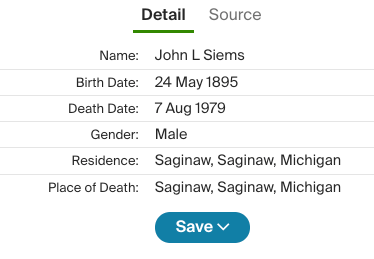
I do not have John’s death certificate, but get his birth and death date and residence at time of death from the “Michigan, Death Index, 1971-1996” database on Ancestry. Another helpful index in the USA is the Social Security Death Index.

A couple other good sources of information are newspapers, which may have an obituary or death notice published, or headstones. A detailed obituary can give specific life details and traits of an ancestor that could not be found in a simple death certificate.

When you search, be careful for duplicate names. While John Siems may be less common than John Smith, if I didn’t already know John was living in Saginaw and died in 1979 I could have easily confused him with the Siems family that was living in Newaygo County, Michigan. Always find corroborating sources to confirm you’ve found the right headstone, death certificate, or obituary.

I can now update my entry on John Siems:

John L. Siems
b. 24 May 1895 in Michigan, USA
d. 7 Aug 1979 in Saginaw, Saginaw, Michigan, USA

Need help with your family history search? Contact us at info@weavingthetapestrygenealogy.com for a free estimate!
Journeying Through Time with the Census

First, I apologize for my extended absence from blogging. A number of things blew up both at work and home. That said, let’s continue our multiple-part census discussion with the 1920 census and beyond!

In the last post, I found evidence of my great grandfather’s home, siblings, work, and general life. This is an excellent starting point, and now it is time to continue working backwards. I have his name, John Siems, birth date of about 1896, and will assume his location is still Bridgeport, Michigan. Plugging in just this information into the search engine gave a great result – he was the first entry!

This time, he was living with his parents John and Margarete as well as his siblings who were listed in 1930. If I had not already known his parents’ names, this would be great additional information! I also know now that the elder John’s parents were both born in Germany, as well as his wife Margarete (as recorded in 1930). This also gives me a timeline – it is very likely both John and Margarete died in the 1920s, as the family was together in 1930 but without their parents.

Screenshot from 2020-02-16 10-41-52

Another interesting bit of information is that Margarete immigrated prior to 1900 and was a naturalized citizen in 1920.

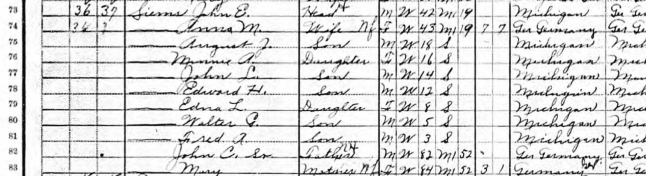
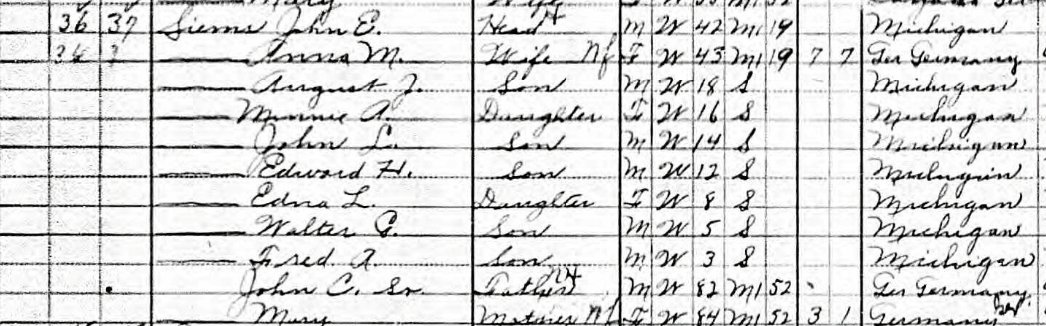
Naturally, the next step is the 1910 census. And I find something fantastic here. Can you spot it in the image below?

Screenshot from 2020-02-16 10-47-56

The first couple lines are interesting themselves…a year of marriage for John E. Siems and Anna M. (Anna Margarete) of around 1891, along with the fact that 7 children were born to them and all 7 were still living.  Counting, we see all 7 are in the household at the time of the census as well. But after the head of household, wife, and sons and daughters, look who we find! The parents of John E. Siems – John C. and Mary. I have found the original German settlers of my Siems line here in the 1910 census.

It does not always happen, but many times we can find the parents, in-laws, siblings, or cousins of our ancestors living with them or next door.

Just from the 1910 – 1930 census records, I have gone back three generations from my grandfather to our first German ancestors in the USA.

These examples are best case scenarios. They were easy to search out, I had a good starting point from oral family history, and everyone was living together and in the same place. However, things are about to get a bit more difficult tracking down the older generations. In my last post of this first census series, I will discuss how I broke through the very first brick wall of my family tree to track the Siems family all the way back to 1860 in Saginaw.

Are you having difficulty in your own census search, need help interpreting what you found, or are ready to move beyond the census? Contact us for a free research proposal, we’d love to help!

Today’s Tip: Use the Catalog!

One of my favorite sites since beginning my genealogy work has been FamilySearch. Not only are the records free to access, but they often have some hidden gems! In particular, I’ve really benefited from the property records for the state of New York in my work. In fact, I really wished there was something similar for Michigan, where most of my research is located.

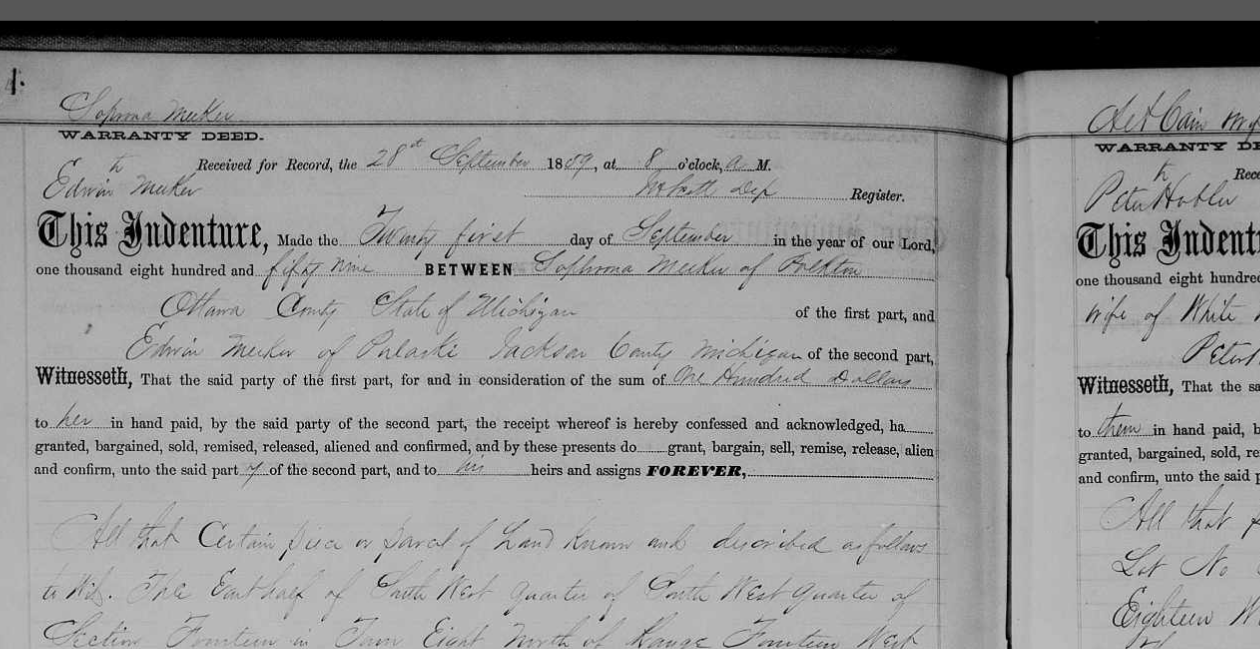
And recently, I discovered that there was. I just was not paying close enough attention! When accessing the FamilySearch catalog for Ottawa County, I can browse through land deed records.

Not only were these great in finding when certain ancestors of mine first moved to the state, but I got a new clue on my elusive Meeker line when I found that my great great great grandmother, Sophrona, had sold her land just around the time her husband Horace Meeker died. The buyer? Someone named Edwin Meeker from nearby Jackson County. I even found some potential DNA match support for Edwin. While I have not made the connection yet, it is a tantalizing clue.

meeker_landrecord

So, when you run out of indexed records, try the catalog! While it is time-consuming to wade through records page by page, you may just find a useful hint lurking in that microfilm.

Don’t have time to wade through long rolls of microfilm, or just having trouble tracking down that vital clue you need? Let me tackle that! Check out our About section for a detailed list of services, or Contact us for a free quote for your project.

Welcome to Weaving the Tapestry!

I’m thrilled to launch my genealogy business, Weaving the Tapestry, where I can help you from anything from a local look up to busting through your brick walls! Please visit my Portfolio for examples of my work, About to learn about my services, and Contact if you wish to learn more! I will also provide interesting stories and genealogy tips here on my blog.

Today’s Genealogy Tip is to help you begin your journey through your family tree. If you have living relatives – parents, grandparents, aunts, uncles – that you are in touch with, talk to them before you begin! Family stories are not always correct, but they normally have some grains of truth in them. Find out names and maiden names of your grandparents, their parents, siblings, anyone and everyone your family knows about. Particularly if you have common names in your family, a list of siblings can help get you started identifying the right family in the 1940 census.

When I first started researching, I found out my grandfather’s aunts and uncles on his father’s side, which allowed me to first find the family in the 1920, 1910, and 1900 US Federal Census records. This was the first step in starting my family tree.