A Little Help from the Newspaper

Unfortunately, sometimes we just can’t find that one birth record or census entry that we need. An excellent alternative to traditional sources of genealogy information is the local newspaper! While not always available, a newspaper article can be an excellent way to fill in missing pieces in an ancestor’s story.

Newspaper repositories are scattered far and wide. There are some large databases, like Newspapers.com or the British Newspaper Archive. If you have a subscription or access via library or free trial, these are a great place to start. The Library of Congress has some digitized papers online, as do many local libraries or universities. Try searching for “newspaper archive <city, county, state, or region>” in your favorite search engine.

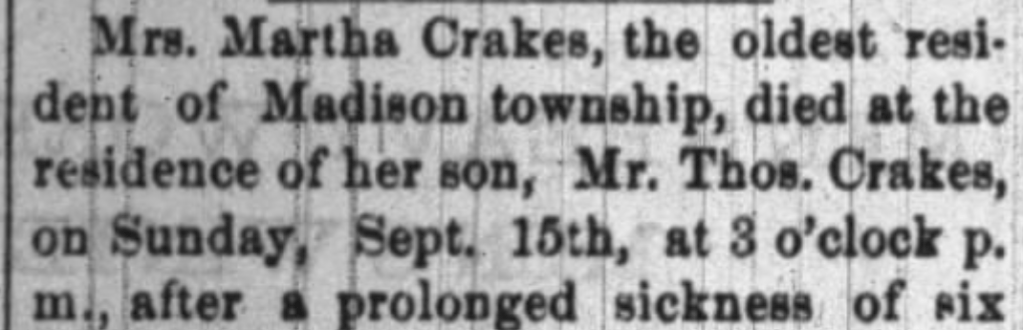
As an example, this is the method I used to find the death information for my 4th great grandmother, Martha Crakes nee Watson. Her obituary was published in the South Bend Tribune and gave me her date and place of death.

Here at Weaving the Tapestry, we’re well-versed in looking at alternative sources to find information about hard to find ancestors. Check out what we have to offer!

BMD Step 3 – Birth Record

We’ve worked back through John’s life to the very first moment: his birth.

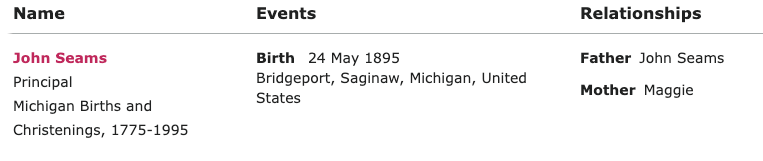
I already know from his death certificate his birth date, and from his marriage record his birthplace. But for completeness, I now search for his birth record. In addition to good genealogy and sourcing practice, it’s possible that the birth record will have contradictory information from the marriage or death records that needs to be sorted out.

As before, if you aren’t already familiar with sources of birth records either to request as an eligible relative/researcher or to search what is publicly available, you can start by searching for “birth records <city, state, or country>”.

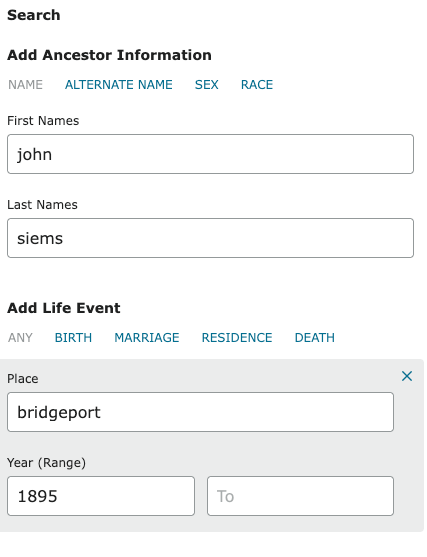
Instead of Ancestry, this time I’m on FamilySearch (an excellent free resource) in the “Michigan Births and Christenings, 1775-1995” database. My search is:

Even though this is accurate to what I’ve found in other records, the search returns no results! When this happens, it’s best to remove some information to increase the chance your search will return something. I like to start with location. Instead of Bridgeport, I will enter Saginaw (the county in which Bridgeport resides). The record I’m looking for is now the first result:

If this doesn’t work, try removing or using soundex or partial search for the last name, or giving a range to the year. Slowly expand your search to give you more results to sort through. As always, be careful for duplicate names and find some corroborating information. Sometimes this all fails, and if you have the patience you can find the record by going through scanned images page by page.

While the birth record does not give me any additional information, it does support the information I’ve already found through other sources and is a good cross check and record to add to my record of John.

BMD Step 2 – Marriage Records

I know from oral family history that John L. Siems married twice, with his first wife being my ancestor. He later married a woman with three children and had his second child, my grandfather’s younger sister.

As with death records, if you don’t know where to start you may want to begin with a search such as “marriage records <city, state, or country>”. Different regions will have different availability of records.

Luckily for me, marriage record entries (if not certificates) are available for Michigan for the dates I need. From a search of the Ancestry database “Michigan, Marriage Records, 1867-1952” I find my great grandfather’s second marriage certificate. In it, I find his mother’s maiden name Popp, that he was previously married once, and he married Maude Schmeider nee Smith and they married in Saginaw.

I don’t have a certificate for his first marriage, but the database does contain his marriage record entry with the county clerk. Again, this record has his mother’s maiden name as well as his birthplace (Bridgeport) and his wife’s name and her parents, getting me back another generation on my grandfather’s mother’s side.

Another critical piece of information that can be found in marriage records are the names of the witnesses. Sometimes these were unrelated friends, or even the minister’s family. Other times, they are siblings or cousins that can give you critical information on family links.

If you can’t find a marriage record, some sources of information include newspaper announcements and obituaries, which may state when or how long the deceased was married. Another source is census records, which may give an estimated date of marriage or, if not a column in the census, the marriage can be estimated based on when the first child was born. This is also useful to narrow down a date range when searching for the marriage records entry.

I can now add to John:

John L. Siems
b. 24 May 1895 in Bridgeport, Michigan, USA
m. 2 Sep 1922 in Saginaw, Saginaw, Michigan, USA to Gretta Tomlinson
m. 16 Aug 1930 in Saginaw, Saginaw, Michigan, USA to Maude Smith
d. 7 Aug 1979 in Saginaw, Saginaw, Michigan, USA

Need help with your family history search? Contact us at info@weavingthetapestrygenealogy.com for a free estimate!

Genealogy Tips are Back!

While Weaving the Tapestry has still been active since the start of the pandemic, the state of life has made it difficult to sit down and blog. However, things have calmed down and the blog is being resurrected!

This week, our genealogy tips will focus on where to go next once you’ve found an ancestor in the census. Scroll down through earlier blog posts for how to get started and start using the census!

Let’s go back to John L. Siems, who we found in the 1930 and 1920 censuses. From the census records, I know:

  • Where John lived
  • The names of his siblings
  • He was born around 1896 in Michigan
  • His father was named John and his mother Margarete

I also know from the 1900 census that they were in Bridgeport, the same town for the 1920 and 1930 censuses too. So, my current entry for John is:

John L. Siems
b. abt. 1896 in Michigan, USA

Once I have his parents’ and siblings’ names, and from asking my relatives know his children and wives, I can fill in that information in my tree. There are three basic pieces of information we strive to find for a person, and these are:

  • Birth
  • Marriage
  • Death

…or BMD.

Typically, it helps to start with the most recent information and work backwards. As you begin your tree, you likely already have this information from personal experience or talking to relatives. If not, it can be a bit difficult to find recent data due to privacy laws.

We’ll start with death, as this is the most recent event for the ancestor. The best source of information would be a death certificate. If you’re a qualifying relative and know where your ancestor died, you can request a death certificate directly from the city or county authority. If not, there are a number of databases that may contain the information. Try searching, “death records <city, state, or country>”.

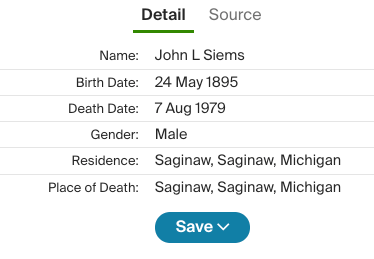
I do not have John’s death certificate, but get his birth and death date and residence at time of death from the “Michigan, Death Index, 1971-1996” database on Ancestry. Another helpful index in the USA is the Social Security Death Index.

A couple other good sources of information are newspapers, which may have an obituary or death notice published, or headstones. A detailed obituary can give specific life details and traits of an ancestor that could not be found in a simple death certificate.

When you search, be careful for duplicate names. While John Siems may be less common than John Smith, if I didn’t already know John was living in Saginaw and died in 1979 I could have easily confused him with the Siems family that was living in Newaygo County, Michigan. Always find corroborating sources to confirm you’ve found the right headstone, death certificate, or obituary.

I can now update my entry on John Siems:

John L. Siems
b. 24 May 1895 in Michigan, USA
d. 7 Aug 1979 in Saginaw, Saginaw, Michigan, USA

Need help with your family history search? Contact us at info@weavingthetapestrygenealogy.com for a free estimate!
The Census – More Than Just a Name

Today is the first of a multi-part post in which I wanted to share some useful tips for using census records. My examples are from the U.S. Federal Census, but can also apply to state census records and census records in the British Isles, or perhaps even beyond.

The U.S. Census remains confidential for 72 years, after which it is released to the public. Census records start in 1790, the first decade of our country’s independence, and are available through 1940. Some county and state level records losses have happened, and of course the tragic loss of the 1890 census for almost the entire country. There are also ethnic variations that may limit the usefulness of these records: American Indians may not find ancestors until more recent records, or in special Indian census records, and African American ancestors who were enslaved will not appear until the first post-Civil War census of 1870.

But let’s say you’ve found your ancestor in a census record. What more does this give you than a name? Loads, as it turns out! I’ll start with a 1930 census example from my own tree.

My grandfather was not living with his father in 1930. I knew that already – my grandfather’s mother had died when he was only about 18 months old and he lived with her sister while his father returned to his home, as back then it was very difficult to successfully live as a single father. Although I already knew a lot about my great grandfather, including his siblings’ and parents’ names, from my grandfather, I still looked him up in 1930.

Screenshot from 2019-12-15 16-46-47

I saw him living with his brother August at their parents’ farm on King Road. Also living with them were his brother Walter and Walter’s new wife Lillian, who was born in Germany, and their youngest brother Frederick. Their two sisters and other brother appeared to be out of the household as well as the parents (presumably deceased). August was not married and was working the farm, but his brothers were out working elsewhere. The census shows my great grandfather was an automobile salesman, something I had never heard. And while the family’s mother was born in Germany as expected, I was surprised to discover their father was born in Michigan.

To summarize, this document gave me the following information:

  • Town and road on which my great grandfather lived
  • Several of his siblings’ names
  • The names of his neighbors
  • His oldest brother owned the farm and worked it
  • They owned a radio
  • He was male, white, 34 years old, widowed, and first married at age 26
  • He did not attend school that year, but could read and write
  • He was born in Michigan, his father was born in Michigan, and his mother was born in Germany
  • He was able to speak English
  • He worked as an automobile salesman for a wage
  • He was not a verteran

While some information is just of general interest, like the fact that they owned a radio or his job, much will help me track him the next census back in 1920. I’ll be able to narrow in on the King Road address and should find him living with a father from Michigan and mother from Germany, along with siblings named August, Walter, and Frederick. He would also be about age 24. It also gives me an approximate year of 1922 for his marriage. And, if I have trouble finding his family (Siems often is written or transcribed incorrectly), I can search for the names of his neighbors to get in the ballpark area where he may be enumerated.

Next post we will visit the 1920 census to see what more we learn of my great grandfather and helpful information available from that year.